

A business can receive more orders, report higher revenue and still become harder to run every week. The danger is not that customers are bad for the business. The danger is that growth increases the speed of every dependency: cash must arrive, stock must be available, people must respond, orders must be fulfilled, and records must agree.
The short answer is yes: more customers can make a business less stable when customer growth outruns contribution margin, cash conversion, operating capacity or control. A larger customer base is valuable only when the business can serve it profitably, collect the money in time, and repeat the experience without relying on heroics.
This article follows one order from demand to cash. That is where the attractive growth story usually becomes more complicated.
What this Insight explains
- Why revenue growth can increase financial pressure instead of relieving it
- How customer volume exposes weak cash, fulfilment and control systems
- Why contribution matters more than sales volume when capacity is limited
- A five-part growth gate you can use before increasing acquisition spend
- Which metrics reveal whether new customers are strengthening or stressing the business
Growth does not remove operational weaknesses. It gives them more transactions to process.
The hidden cost of a new customer
A new customer does not create only a sale. The customer creates a chain of work and timing commitments.
Before the sale, the business may pay for marketing, content, sales time or a marketplace fee. At the sale, it may commit stock, packaging, delivery, payment processing and customer communication. After the sale, it may carry returns, refunds, support, warranty or repeat-service obligations.
That means the real question is not only: How much revenue did the new customer create?
The better questions are:
- How much contribution remains after the costs that move with the order?
- How long before the business can use the cash?
- What additional capacity does the order consume?
- What failure becomes more likely at this volume?
- Does the customer return, refer or create expensive support work?
A customer can be profitable in the income statement and still be uncomfortable in the cash account. A customer can also be good for revenue while being unattractive at the margin. These are not contradictions. They are different views of the same operating system.
Four ways customer growth makes a business more fragile
1. Growth can consume cash before it produces usable cash
Revenue is recorded when the sale meets the business's accounting rules. Cash becomes usable when the business actually receives it and is not required to hold it for a deposit, refund, supplier payment, tax obligation or another commitment.
Consider a product business that grows from 100 orders a month to 300. To fulfil the larger volume, it buys stock earlier, increases packaging, pays for more delivery capacity and perhaps gives customers longer payment terms. The sales line rises immediately. The cash burden may arrive first.
The simplified operating cash pressure can be expressed as:
Cash tied up in growth = increase in inventory + increase in receivables - increase in supplier credit
Suppose growth requires an additional 12,000 currency units of inventory and 4,000 in unpaid customer balances, while suppliers provide 5,000 of additional credit. The business has absorbed 11,000 currency units before considering the next payroll, tax payment, refund or delivery bill.
IFRS guidance on cash-flow reporting shows why this matters: the indirect method adjusts profit for changes in inventories and operating receivables and payables. Those balances can move cash even when the income statement looks healthy. The lesson is not that accounting is complicated. The lesson is that growth has a timing problem.
2. Volume can multiply exceptions
A small business often survives on informal knowledge. The founder knows which customer is waiting, which product is reserved, which supplier is late and which payment has not been matched to an order.
That can work at low volume. It becomes dangerous when the same person must remember hundreds of exceptions across several channels.
At 40 orders, a missed handover may be annoying. At 400 orders, the same weak process can create refunds, duplicate dispatches, angry messages, stock discrepancies and staff overtime.
Complexity does not rise only because the number of orders rises. It rises because each order can have different states:
- paid or pending
- in stock or awaiting replenishment
- standard sale or preorder
- one item or split shipment
- delivered or awaiting collection
- clean payment match or unallocated payment
The business is no longer managing orders. It is managing order states. If those states are not visible, growth turns memory into an invisible operating cost.
3. Acquisition can outrun contribution
Revenue is a starting point, not a verdict.
Contribution is the amount left after the costs that move with the sale. A useful simplified formula is:
Contribution per order = selling price - product cost - payment cost - delivery cost - packaging - variable selling cost - expected returns or service cost
For a practical walkthrough of product costs, markup and margin, see How to price a product without guessing.
An acquisition campaign can look successful because it creates a large number of customers. But if the campaign attracts discount-sensitive buyers, requires expensive delivery or produces a high return rate, the contribution from each new order may be thin.
Here is an illustrative model using currency-neutral units:
| Measure | Before growth | After growth |
|---|---|---|
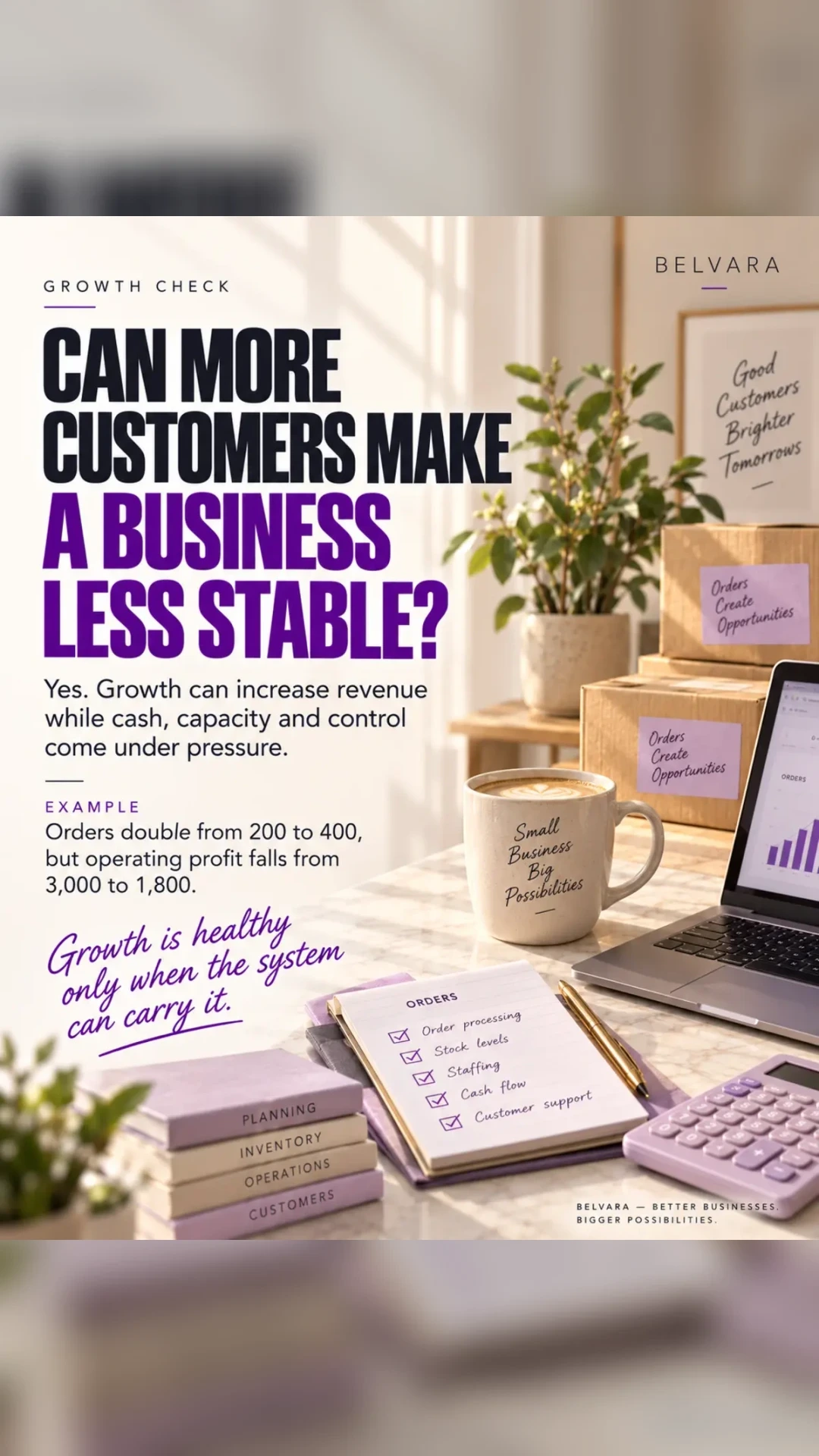
| Orders | 200 | 400 |
| Revenue per order | 100 | 100 |
| Revenue | 20,000 | 40,000 |
| Variable cost per order | 60 | 68 |
| Total contribution | 8,000 | 12,800 |
| Fixed operating cost | 5,000 | 11,000 |
| Operating profit | 3,000 | 1,800 |
Revenue doubled. Operating profit fell by 40%. The business did not fail because customers were unprofitable in the abstract. It failed the growth test because variable costs and fixed capacity expanded faster than contribution.
The question is not whether growth creates more sales. The question is whether each layer of growth leaves enough behind to carry the next layer.
4. Growth can damage the promise that created demand
A business may attract customers because it is responsive, precise, personal or fast. Rapid growth can weaken exactly those qualities.
Response times lengthen. Stock information becomes unreliable. The product description no longer matches what is available. Returns take longer to resolve. Customers who paid for a premium experience receive an improvised one.
This creates a second-order problem. The business must spend more time recovering trust while also trying to serve more customers. The acquisition engine keeps adding demand to a system that is losing the ability to fulfil its promise.
Growth therefore has a quality threshold. Once the customer experience falls below that threshold, more acquisition may increase complaints and refunds faster than it increases durable demand.
The five-part growth gate
Before increasing acquisition spend, adding a new sales channel or accepting a major wholesale order, test growth against five conditions.
| Gate | Question | Evidence to review |
|---|---|---|
| Contribution | Does each new order leave enough after variable costs? | Contribution per order and by channel |
| Cash | Can the business fund the delay between paying and collecting? | Cash forecast, inventory, receivables and supplier terms |
| Capacity | Can the team fulfil demand without breaking the promise? | Orders per person, response time, fulfilment time and backlog |
| Control | Can the business know what is paid, reserved, dispatched and outstanding? | Reconciled payment, stock and order records |
| Customer quality | Do new customers create durable value? | Repeat rate, refunds, returns, support load and referrals |
Do not treat these as universal pass-or-fail thresholds. A delivery business, a subscription company and a handmade product brand will have different economics. The point is to make the assumptions visible before spending more money.
A practical scoring method
Score each gate from 0 to 2:
- 0 = unknown or deteriorating
- 1 = visible but under pressure
- 2 = measured and within the operating plan
A total of 8 to 10 does not guarantee safe growth. It means the business has enough visibility to make a deliberate bet. A total below 6 is a signal to repair the constraint before buying more demand.
The most important rule is this: a zero in Cash or Control is not cancelled out by a two in Customer quality. A business cannot pay suppliers with a strong retention story, and it cannot reconcile a bank account with enthusiasm.
Measure the customer, not just the transaction
Monthly revenue hides the differences between customers and channels. A stronger review follows the customer journey:
- Acquisition cost: what did it take to attract the customer?
- First-order contribution: what remained after direct and expected service costs?
- Cash timing: when did the business receive usable cash?
- Fulfilment quality: was the promise delivered on time and correctly?
- Repeat behaviour: did the customer return, refer or expand the relationship?
- Support burden: how much human work did the customer require?
Review these by cohort, channel and product. An average can conceal the segment that is consuming the business.
For example, one channel may bring 100 customers with a 30% repeat rate and low support demand. Another may bring 150 customers with a 4% repeat rate, high discounts and frequent delivery problems. The second channel looks bigger. The first may be the better growth engine.
What to do when growth is stressing the business
If the business is already under pressure, do not respond automatically by chasing even more sales. Diagnose the constraint.
- If cash is tight, slow stock commitments, tighten payment terms and build a short cash forecast.
- If contribution is weak, review discounts, delivery, payment fees, product mix and acquisition cost.
- If fulfilment is failing, reduce exceptions, define service levels and make order status visible.
- If records are unreliable, reconcile payments, stock and orders before adding another channel.
- If repeat purchase is falling, investigate the broken promise before increasing acquisition.
The right move may be to grow one channel, product or customer segment while pausing another. Selective growth is still growth. It is simply growth with a boundary.
Common mistakes
Mistake 1: Treating revenue as proof that growth is working
Revenue answers how much was sold. It does not answer what was left, when cash arrived or how much capacity the sale consumed.
Mistake 2: Using one average for every customer
Channels, products and customer cohorts can have different contribution, repeat and support economics. Segment before deciding.
Mistake 3: Hiring before mapping the bottleneck
Additional people can increase coordination work if roles, approvals and handovers are unclear. Identify the constraint before adding capacity.
Mistake 4: Adding software before defining the source of truth
Software can make a visible process faster. It cannot decide which record is correct when the business has no agreed payment, order or stock state.
Mistake 5: Scaling the promise informally
If the business's best customer experience depends on one person remembering every exception, the experience is not yet scalable.
How Belvara helps you see growth as a connected system
Belvara is designed to keep the records behind a business decision closer together. Explore the wider Belvara Insights, Belvara Guides and Belvara Glossary library for connected business explanations and practical workflows. Sales, verified payments, stock movements, fulfilment activity, customer history and finance records should tell the same story about what happened.
For a growing business, that context matters. A rise in sales should be reviewable alongside payment status, stock pressure, customer history and the financial record. That helps the owner investigate whether growth is creating contribution, cash and repeat demand, or merely more activity.
Belvara does not replace judgment. It gives the owner a clearer operating record from which to exercise it.
Final answer
More customers can make a healthy-looking business less stable when the business cannot convert demand into contribution, usable cash, reliable fulfilment and repeatable control.
The solution is not to fear growth or to chase it blindly. Put a gate around it. Measure contribution, cash, capacity, control and customer quality. Then choose the next growth bet that the business can actually carry.
A business is ready for more customers when more customers make the system stronger, not merely busier.

FAQ
Frequently asked questions
Can a business grow revenue and become less profitable?
Yes. Profit can fall when discounts, delivery, payment fees, returns, support, payroll or other operating costs rise faster than revenue. Review contribution per order and fixed capacity, not revenue alone.
Why can profitable growth create a cash shortage?
Growth may require inventory, equipment, staff or marketing payments before the business collects customer cash. Receivables and inventory can absorb cash even while the income statement reports profit.
How do I know whether my business is ready for more customers?
Test contribution, cash funding, fulfilment capacity, record control and customer quality. The business should know what will happen if order volume rises and which constraint will be reached first.
Should I stop marketing if operations are under pressure?
Not automatically. Reduce or redirect the demand that is creating the constraint, then repair the bottleneck. You may keep the strongest channel while pausing an expensive or operationally unstable one.
Is hiring enough to make growth safer?
No. Hiring helps only when it adds capacity to the actual bottleneck. Without clear roles, workflows and ownership, more staff can add handovers and coordination cost.
What is the most important growth metric?
There is no single universal metric. Start with contribution per order, cash timing, fulfilment reliability and repeat behaviour. Review them by product, channel and customer cohort.
Can small businesses use this framework without complex software?
Yes. Begin with a simple order register, cash forecast, contribution calculation and weekly exception review. Software becomes more useful when the business has defined the records and decisions it needs.